The true story of the Arlington Bar and the Stone of Destiny
Post written by Sally Foster |
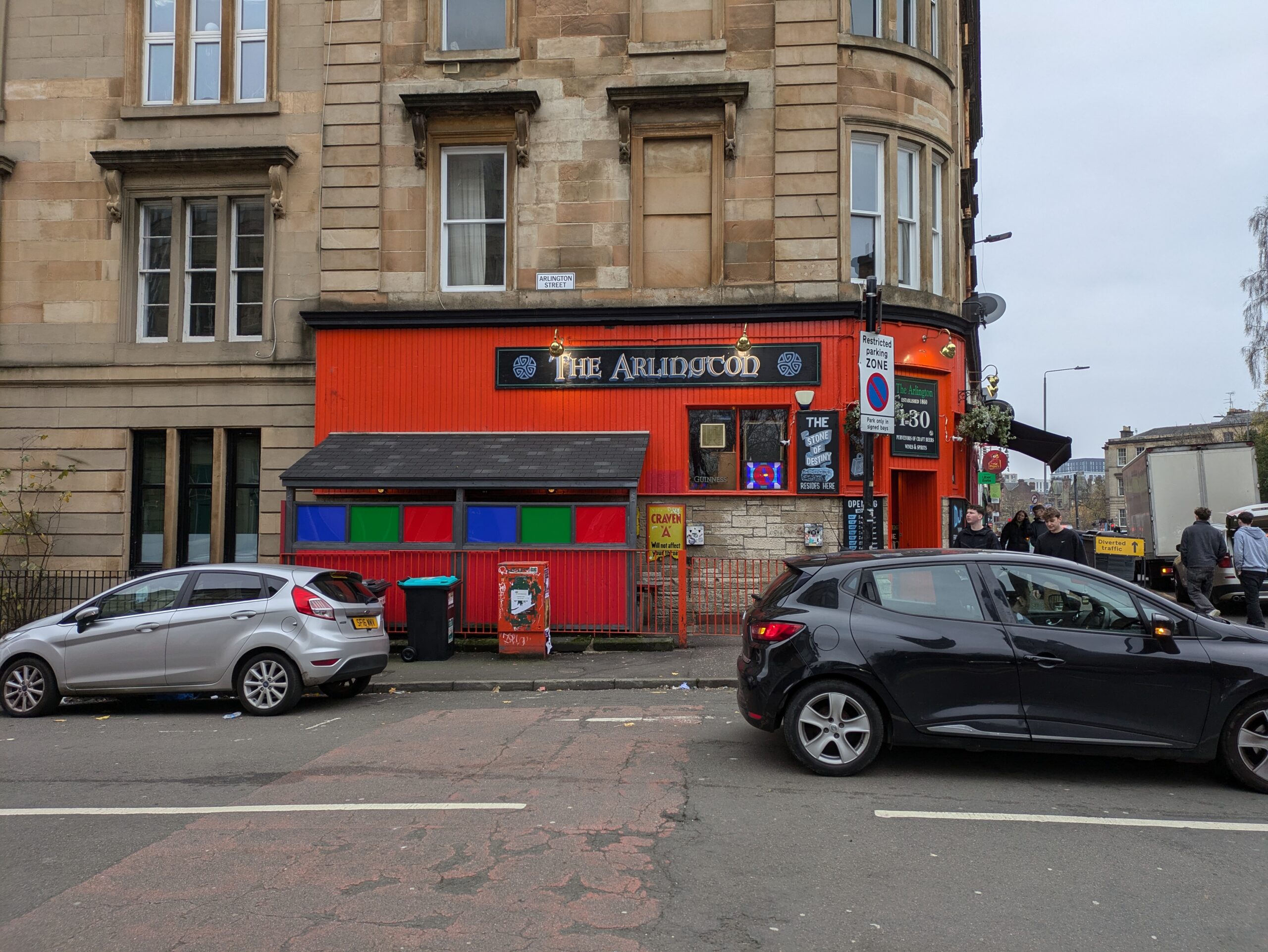
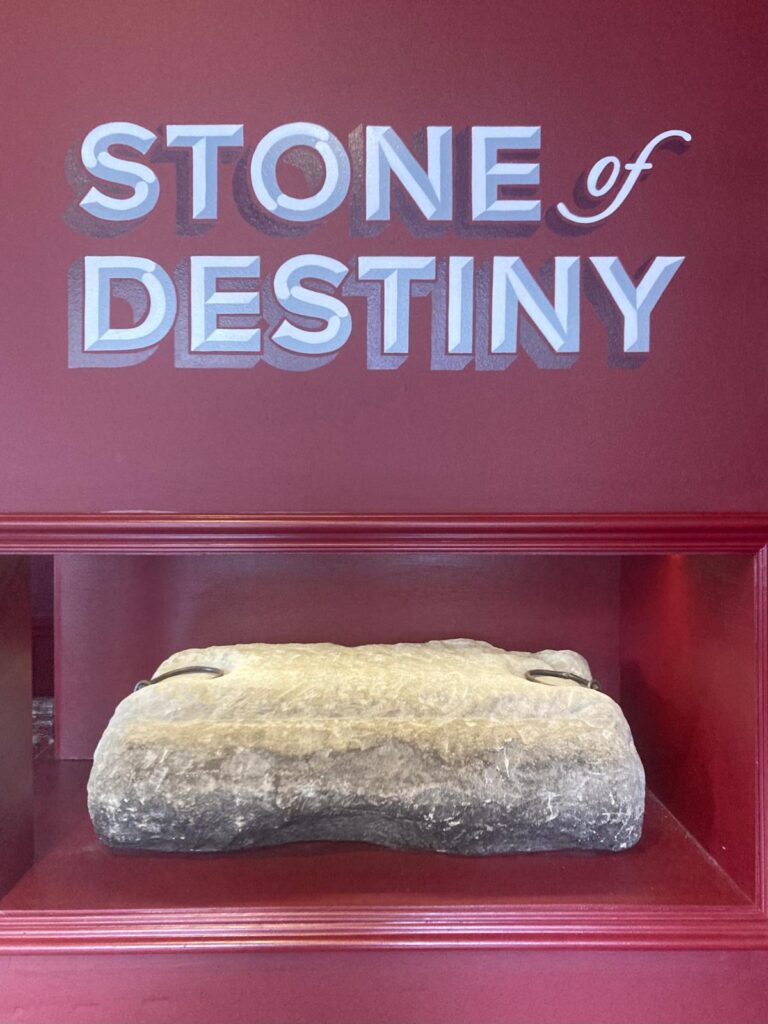
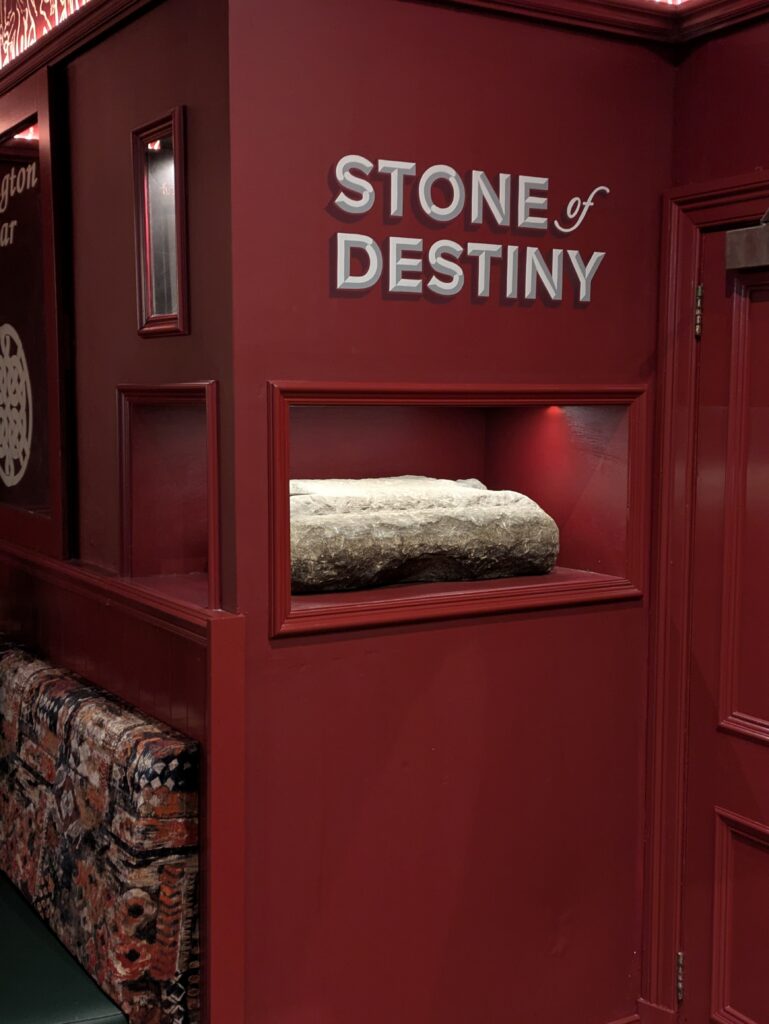
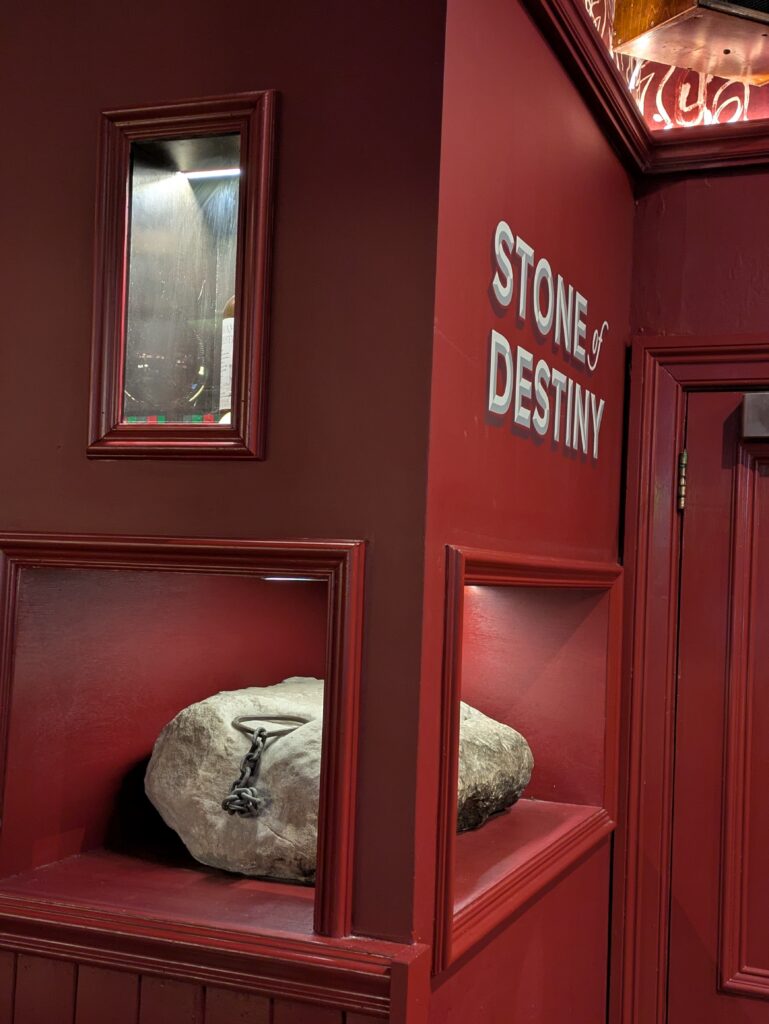
Walking down Woodlands Road in Glasgow last week, I spotted that the famous Arlington Bar has had a makeover and its ‘Stone of Destiny’ has been redisplayed (the image above shows what it used to look like externally). Inside the revamped pub, it has now been moved to a central corner where it’s much easier for visitors to access, view from two sides, and indeed, touch (see below, image to left by Dave Paton). The painted noticeboard recounting its colourful history, under which it was previously inset in the pub’s back wall, is now largely masked by a large TV screen.
Is it a Bertie Gray replica?
The Arlington Bar has made claims that they have the real Stone, as reported in the Herald for 30 March 2007. Patrick Leddy, the area manager, was quoted as saying, ‘It’s true the students did bring it back to the Arlington But this is definitely the real one’. Joan Leroy, the pub’s manager told the journalist that it had been found beneath a boxed pub seat, where it was claimed to have lain since the 1950s.
The panel under which the Stone was displayed from 2007 until recently describes the story as follows:
From the 13th Century Kings & Queens have been crowned uponTHE STONE OF DESTINYSeven centuries after Edward Longshanks marched triumphantlyout of Scotland with the ancient symbol of Caledonian nationhoodeffectively tucked under his arm, the Stone of Destiny crossed theBorder again in 1996 receiving an emotional homecoming in Edinburgh,After being held at Westminster Abbey for seven centuries.
The Stone however already came back in 1950. Daring students from GlasgowUniversity stole it from Westminster Abbey on Christmas morning!Road blocks were set up yet the Stone still made it north to Glasgow.For a respite these thirsty students carried it from their car and placedIt on the bar of “The Arlington” whilst enjoying a pint.
Within two weeks the game was up and the police were tipped off thatthe Stone could be found at “The Arlington”. Under pressure the studentsdecided to hand it back … Or did they? Stories abound across Scotlandthat the students handed a replica to the police and that the “real”Stone is here in the “Arlington Bar”
A previous owner told me they were baffled why people got so interested in it, despite it so obviously not being the Stone: ‘My biggest takeaway was how many people were switched on by this, even though a fake, something people pay homage to’.
This is fascinating and quite another story. People don’t though ask me if it’s the real Stone. Instead, I am repeatedly being asked if it’s a Bertie Gray copy. The answer is no.
Bertie Gray was the Glasgow businessman (monumental sculptor) and Councillor who materially assisted the four students who took the Stone from Westminster Abbey on Christmas Day 1950, steered the Stone’s covert movement around central Scotland, its repair and its return. He curated and circulated tens of fragments of the Stone, by-products of its repair (see my article here).
Gray did not talk to the media about his fragment activity but, until his death in 1975, he nurtured the story that he had cared for three stones at once (real Stone, two replicas that he had made): he could not distinguish them, muddled them up, so the Stone back in the Coronation Chair in London could be a replica. The present location of any Gray replica is currently not known. On the basis of my research, the form and dimensions of the Arlington replica do not match any documentary or visual records for the twentieth-century replica or replicas made by Bertie Gray.
So what is it?
The stone in the Arlington is a very modern replica. It’s a great example of successful modern branding, to be happily imbibed along with the pub’s exclusive ‘Stone of Destiny’ lager.
But I am not the first to say this. Ewan Campbell of Glasgow University was interviewed not long after the Arlington made its claims in 2007. Ewan tells me that it’s made from local Carboniferous sandstone rather than Perthshire sandstone, and we both have observed how it’s a roughly dressed building stone. While the dressing is not new, the metal attachments certainly are. A previous owner advised me that an earlier owner, Mr Sean Murphy, got a stone mason friend to create this replica. There is another pub story, that the Stone was found to be built into a fireplace in the cellar, but whether that was the source of the building stone that was used in the Arlington replica is something that cannot be confirmed.
There is no evidence I am aware of that the replica predates the 2007 pub makeover.
It would be poor academic sport as well as unproductive to systematically pick apart the veracity of the pub’s claims. But why were the pub’s 2007 bosses keen to ‘capitalise on the hostelry’s place in history’ (Herald article above). It is no coincidence that the creation of the Arlington replica follows the 1996 return of the Stone to Scotland and immediately precedes the 2008 release of a Hollywood film about how the Glasgow students took the Stone. For the Arlington has a genuine earlier connection with the Stone.
Back story 1951 to 1996
There is no known basis in fact that the Stone, or a part of the Stone, was ever in the pub. However, we do know the Arlington was one of two main pubs in which Ian Hamilton and some others involved in the Stone conspiracy would drink. Hamilton was the lead student responsible for the Stone ‘heist’. He and his fellows made merry with that association.
Hamilton first tried to remove the Stone from Westminster Abbey on 23 December 1950 by getting locked in the Abbey once all the visitors had left. Discovered by a watchman and required to give his name and address, he quickly thought of ‘John Allison, Arlington Street, N14’. When the conspirators left a letter on the door of St Giles’ Cathedral at the end of January 1951, they confirmed that their identity was real by reusing this hoax name and address, immediately reported in the media.
As the students and others were being brought in for police questioning at the end of March 1951, at the point when the Stone was about to be repaired in advance of handing it back in Arbroath on 11 April 1951, an article appeared tellingly entitled ‘Back of saloon car. Over drinks in public house 13 conspirators laid the plot’. This source suggests that a conspirator, who we must assume to be Hamilton, drunk at the Arlington.
The thirteen conspirators used two public-houses in Glasgow as meeting places. The name of one of these bars actually inspired a fictitious address to which Scotland Yard were directed by an anonymous caller soon after the Stone disappeared. The message was intended to throw the police off the scent, but it has boomeranged with this significant clue (Press and Journal, 22 March 1951).
The number thirteen is suspiciously biblical. Hamilton, does not mention any of this in his 1952 book about the heist, although he is the source for a similar statement the day after the Stone was returned, on 12 April 1951. Here he publicly states for the first time that it was he who used the false ‘Arlington Street’ address. That article also tells us that six of them ‘went to London and others distributed themselves along the return route’, something that, again, he does not mention in his book.
The other pub the students drunk in was the Saracen’s Head in Gallowgate, according to Vivienne Rollo. Her father was David Rollo. Along with his flatmate Gavin Vernon’s (one of the four to take the Stone), the police brought him in for questioning. Rollo was one of three students who Hamilton approached to come with him to Westminster that had declined.
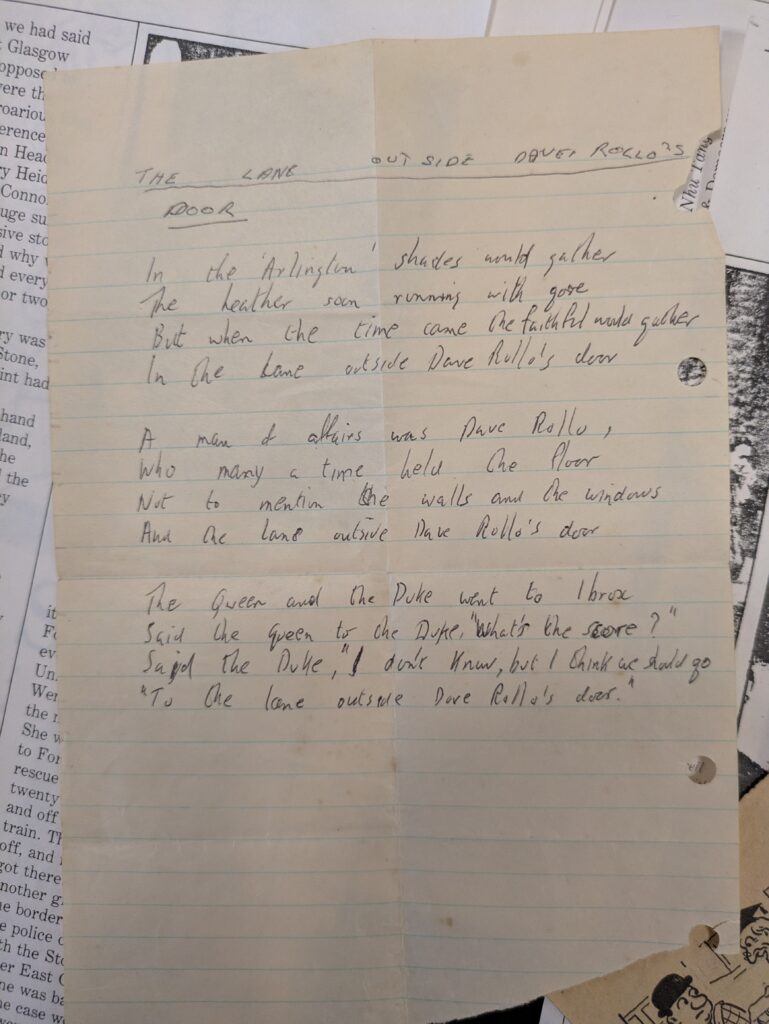
As told to be me by Vivenne, Rollo was immortalised in a song by John McEvoy (composer of ‘The Wee Magic Stane’) for the parties that continued in his house, after sessions at the Arlington:
The Lane outside Dave Rollo’s Door
In the ‘Arlington’ shades would gather
The heather soon running with gore
But when the time came the faithful would gather
In the lane outside Dave Rollo’s door.
A man of affairs was Dave Rollo,
Who many a time held the floor
Not to mention the walls and the windows
And the lane outside Dave Rollo’s door.
The Queen and the Duke went to Ibrox
Said the Queen to the Duke, “What’s the score?”
Said the Duke, “I don’t know, but I think we should go
“To the lane outside Dave Rollo’s door.”
Photo of Dave Rollo’s record of the song. Photo Sally Foster, courtesy Vivienne Rollo
The fact is that stories about the Stone emanated from students who drunk in the Arlington. As the John McEvoy song suggests, the Arlington had quite a reputation in the 1950s, and its association with students and nationalists, including those involved in the Stone conspiracy, is unequivocal.
Marking the ten-year anniversary of the heist, an Evening Citizen journalist noted that ‘The Arlington public house has become a rumour factory where students with a thirst and no scruples lay in wait for Sassenach reporters’, which suggests early mischief in terms of storytelling. His source, or one of them, had intimate knowledge about sand being used in the Stone’s cement repair and hiding of the Stone in Killearn, bricked in under a retaining wall. Notably, this was a stage in the life of the Stone that none of the students is known to have played a part in at the time. Quite what stories were being invented between 1950 and 1960, and by whom, we simply do not know. The boundary between fact and fiction were deliberately blurred.
The journalists, ship-builders and taxi-drivers who drank in the pub in the 1990s certainly talked about the Stone having been hidden in the pub, and a replica returned to the authorities, but there was no stone in the pub at this stage.
Back story 1996 to 2008
This lore is the context in which, come 1996 and the planned return of the Stone to Scotland, the Arlington Bar put in a formal pitch to a Scottish Government offering to display the Stone. This is the first time we learn of the Stone ever having allegedly been in, or hidden in, the pub.
The most outlandish suggestion is that it should be displayed in the New Arlington Bar in Glasgow from where, the Arlington Lithogenous League claim, it was briefly hidden in the pub after the 1950 theft (Aberdeen Press and Journal, 17 August 1996)
The bar is reputed to be the very one in which Nationalists hatched the plot to steal the Stone from Westminster Abbey in the early 1950s and where it briefly rested while being repaired (Liverpool Echo, 17 August 1996)
The media covered this story extensively. I love the notion of the Arlington Lithogenous League, for lithogenous relates to organisms, such as coral, that secrete stony deposits. It evokes the Stone’s multiplication.
Cheers!
That the Arlington Bar’s Stone is so very well-known says a lot about the public appetite for myths about the Stone, and for fun with the Stone. The contemporary stories, and the past reality, involve giving the (English) authorities, and journalists, quite a run for their money. This was all delivered with mischief and humour by generations of drinkers at the Arlington Bar.
While not far away …
This postscript (added 30 July 2026) relates to the Glasgow University Union, for one source reports a tradition that the Stone spent some time hiding there on its return to Scotland, and in some ways mirrors the Arlington story. Douglas Beattie reported in the Glasgow University Guardian for 2 October 1997, p5, that ‘Yet another Stone, either the Westminster original or the replica, is persistently said to be resting in a place much closer to home. It may come as little surprise to hear that this is said to be enclosed within the (hallowed) walls of the GUU, quite literally. Apparently deposited for safekeeping in 1951 the Stone is thought to be concealed in the Bridie Library on the second floor of the Union, either behind the fireplace or the wood panelling. Others claim that it is actually hidden beneath the Debates chamber. When asked (off the record) about this matter prominent members of the GUU today, make no denial of any such claims.’ The same source mentions the Arlington Bar’s [1996] claim to house the Stone on its return to Scotland but does not mention any traditions about it already having a stone …
Acknowledgements and sources
My friends who drunk in the Arlington as students. My other sources included the following:
A review of over 800 historic newspaper sources that specifically relate to the Stone, collected by Scottish Government bodies, including Historic Scotland, Westminster Abbey and Kay Matheson (Gairloch Museum Archive).
Detailed examination of the Arlington stone on 9 November 2024
An interview with a former owner of the Arlington in November 2024
An interview in May 2025 with Vivienne Rollo, whose father David Rollo belonged to the inner circle of people associated with the taking of the Stone in 1950; pers comm 30 May 2025
Pers comm Dr Ewan Campbell, 19 June 2025
Pers comm Lesley Richardson who worked in the Arlington 1992-1997, March 2026 (well met at a village Burns supper!)
Aberdeen Press and Journal, 17 Aug 1996. ‘Scone presents rock-solid case to house stone’
Daily Telegraph, 19 Oct 1996. ‘Destination Edinburgh for the stone’, by Joy Copley
Evening Citizen Dec 1960, ‘The Stone. The whole truth at last. 10 years later … and the men who shook Scotland have no regrets’, by Alastair Borthwick
Hamilton, Ian. 1952. No Stone Unturned. The Story of the Stone of Destiny. London: Victor Gollanz Ltd
Glasgow Herald, 1 Feb 1951. ‘Stone letter may have been a hoax. Publicity move’
Liverpool Echo, 17 Aug 1996. ‘Stone me, they’ve all got sights on destiny’, by Bill Doult
People’s Journal, 4 March 1967. ‘They taken the Stone of Destiny. Now it seemed that we would fail again. By Ian Hamilton
Press and Journal, 22 Mar 1951. ‘Back of saloon car. Over drinks in public house 13 conspirators laid the plot’
Scotsman, 31 Jan 1951. ‘Stone of Destiny message. Typewritten document found at door of St Giles’ Cathedral
Scotsman, 12 April 1951. ‘How the Stone was removed. Story of 15 weeks search by Scotland Yard officers’