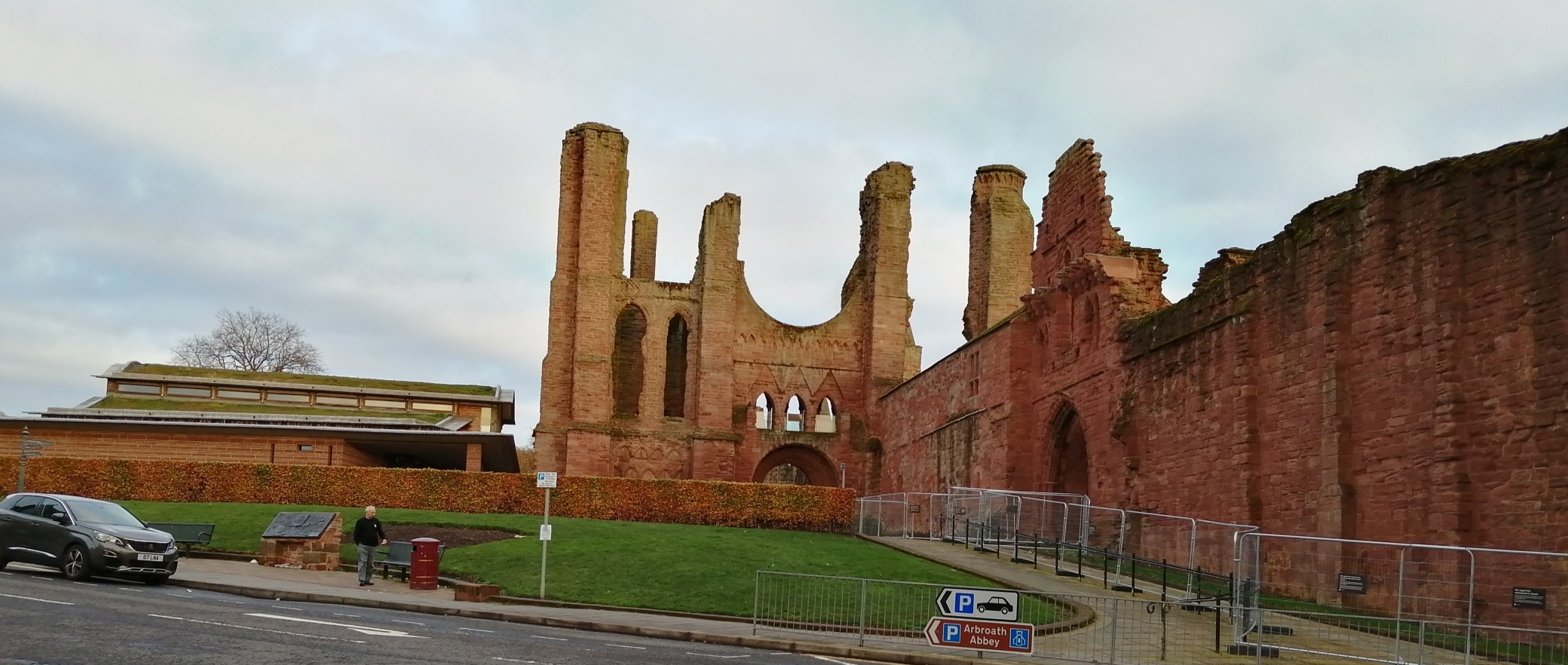
Since 1951, the people of Arbroath have experienced a right-royal pageant of Stone of Destiny replicas. This attractive Angus fishing port, the ruins of its medieval Abbey such a distinctive feature of its skyline, has a history with multiple versions of the Stone of Destiny, including the historic original. But the story about these is confused, with their lives often conflated or asserted without supporting evidence. This blog considers what we can say with confidence, including about the replica on display at the Arbroath Abbey Visitor Centre. It is the outcome, primarily, of a review of newspaper sources, and material supplied by a chain of local informants, people with living experience of what happened. The broader academic context is my ongoing work on Bertie Gray and his replicas of the Stone (see below).
I work on the basis that replicas are objects in their own right, with interesting and important lives. If we seek to understand them and the values that attach to them, in the past and now, we can then engage with them to tell meaningful stories in the future (see www.replicas.stir.ac.uk).
Arbroath’s association with the Stone of Destiny began on 11 April 1951. The Stone had been illicitly removed from the Coronation Chair in Westminster Abbey on Christmas morning 1950, hidden in Scotland and then returned, left for collection on the Abbey’s high altar. The people behind this were seeking Home Rule for Scotland, from an all- and non-party perspective. They selected Arbroath Abbey because of its historic and symbolic association with Scotland’s struggle for independence from England. In 1320, the barons and community of Scotland had asked the pope for independence from England, signing what we know as the Treaty of Arbroath.
Most recent replicas
Replicas of the Stone do tend to pop up in and around Arbroath. The year 2008 saw a resurgence in popular interest in the Stone of Destiny with the release of a Hollywood film about the 1950 heist of the Stone from Westminster Abbey, its dramatic finale filmed in the Abbey. First Minister Alex Salmond exploited the interest in the film to repeat his view that the Stone in Westminster was a fake (by which he meant a medieval fake). This local, national and indeed international interest in the Stone is the context in which a self-confessed ‘serial hoaxer’ from Arbroath alleged he had found the real stone in a cave at Inverkeilour near Arbroath. In 2013, the same man tried to sell a crude copy of the Stone for £1,000 on Gumtree. It may be no coincidence that this is around the time that local papers had been covering a drive for Historic Environment Scotland to do more at the Abbey to tell Arbroath’s Stone of Destiny story.
Earliest documented appearance of a replica of the Stone in Arbroath
We see something similar happening in January 1972. A replica of the Stone made a brief appearance in front of the Abbey at a political demonstration organised by a group calling itself ‘Scottish Activists’. As reported in The Scotsman, as well as local newspapers, they were asking ‘all Scots, irrespective of their political allegiance, to join forces for an independent Scotland’. Local politician Jim McGugan jumped onto the fish lorry carrying the stone and the Saltire was removed to briefly reveal what was claimed to be the genuine Stone of Destiny.
Captured in a photograph in The Scotsman for 24 January 1972, the distinctive stone is demonstrably the replica that other sources confirm ended up later that year in St Columba’s Church, Dundee. Here, the Scottish Knights Templar revered it as the real thing. In a future publication I will address in detail how and why this is the replica made for/by Glasgow Councillor Bertie Gray. Gray’s agency is key to understanding the taking of the Stone in 1950, its hiding, repair, creation and circulation of fragments of the Stone, and creation and use of at least one replica. He ran a monumental sculpture business from Glasgow’s Sauchiehall Street.
Between 1963 and his death in 1975, Gray nurtured the idea that he had made two replicas of the Stone and might not have returned the real Stone to Westminster Abbey: ‘I had three stones when I repaired what was thought to be the Stone of Destiny. They could easily have been mixed up’ (Glasgow Herald 1963).
The fish lorry is a vital clue. Arbroathian Jim McGugan has relayed to me what he was told by local fish merchant and ‘political steerer upper par excellence’, Morris Scott. Morris had asked Gray if he could get one of his ‘spares … for any future ploy that might appear on the horizon’. He collected the replica from the ‘builder’s yard where it lay in the open and had grown a good blanket of moss’. According to a 2008 report in the Courier and Advertiser for 17 June 2008, Morris ‘travelled with Brian Hosie, the uncle of Dundee East MP Stewart Hosie, to premises used by Mr Gray in Glasgow to move a stone after the council announced it was building a dual carriageway through the area’. (The inner city section of the M8 was built through Glasgow between 1968 and 1972.)
Morris Scott duly activated the replica in a mischievously provocative way, for nationalist ends. In Arbroath the replica was hidden by various people, including Tam Walker (pers comm, 2024). It was then ultimately delivered to the 1320 Club in Dundee, by an unknown route. The 1320 Club was a campaign group of notable Scottish nationalists. Reverend John Nimmo of St Columba’s Church was minister to the Scottish Knights Templars, to which several 1320 Club members belonged.
The lay historian Archie McKerracher (d. 2001) wrote a lot in popular magazines and books about the Stone. He was interviewed for the BBC’s radio programme ‘So who’s got the Stone?’, broadcast in January 1987. He (like Morris Scott, according to a 17 June 2008 account in the Courier and Advertiser) believed that the historic original was secretly hidden in the Arbroath area. But McKerracher believed the hidden original was occasionally paraded through Arbroath. My suspicion is that he heard about the 1972 event mentioned above and either believed the replica was the original, or content to allow others to believe it was the original. Local sources have confirmed to me that there has been no other occasion before 2000 in which a replica of the Stone of Destiny has appeared on the streets in Arbroath, and that includes in the context of the Arbroath Pageant (see below).
Norman Atkinson, former Director of Cultural Services at Angus Council (1999–2013) has helped me enormously to shed light on the various replicas, including sharing an invaluable folder of press clippings and other sources. Through him, local Tam Walker has kindly revealed that he was one of the people who hid the stone in Arbroath: ‘one of the “copies” of the Westminster stone once sat for a few days in James Street, in the boot of the old Rover I had back then, before it was taken to an even more secret location near Arbroath Harbour, before ending up elsewhere … in a Dundee Church or with Knights Templars’. He could not recall which of the latter, but it was both (see above).
Morris Scott told Courier and Advertiser journalist Andrew Jarret, a few further details, which do, however, confuse my understanding. He says, ‘the stone we took from the [railway] siding at Arbroath to the basement of what was then Mr and Mrs Simpson’s café at the harbour [now the Smuggler’s Tavern] was eventually taken to Douglas Drysdale in Hillfoot, who made a casing for it. This was apparently the same one which was moved to the St Columba’s Church in Dundee, but there was a service to dedicate it, which I was at, and it was not the same stone we dropped off (17 June 2008).
Photographic evidence that I have seen very definitely confirms that the replica in St Columba’s Church was the one on the back of the fish lorry in 1972. Bertie Gray himself confirmed this. Possibly, there might be an advantage in sowing seeds of confusion for political (nationalist) reasons about the authenticity of the Stone of Destiny; possibly there might be an advantage in confusing the identities and numbers of the replicas. Or was Scott actually hinting at there being at least two replicas because he handled both of them, but could not or did not remember which was when and where?
What of the replica in the Arbroath Abbey Visitor Centre?
For there is another replica in Arbroath, the life story of which is completely unknown. This is the replica on display since 2014 in Historic Environment Scotland’s Visitor Centre at the Abbey (HES Accession no E1281). Here, the signage describes it as:
Imitation Stone of Destiny, 20th-century. This version of the Stone of Destiny was used as a prop in the [Pageant] Society’s performances. These have included dramatisations of both the English invasion of 1296, when the Stone was taken to London, and the events of 1950 [sic], when it was brought back to Scotland and left here at the abbey.
I can find no evidence of a pageant link, and HES has only been able to locate scanty records for themselves.
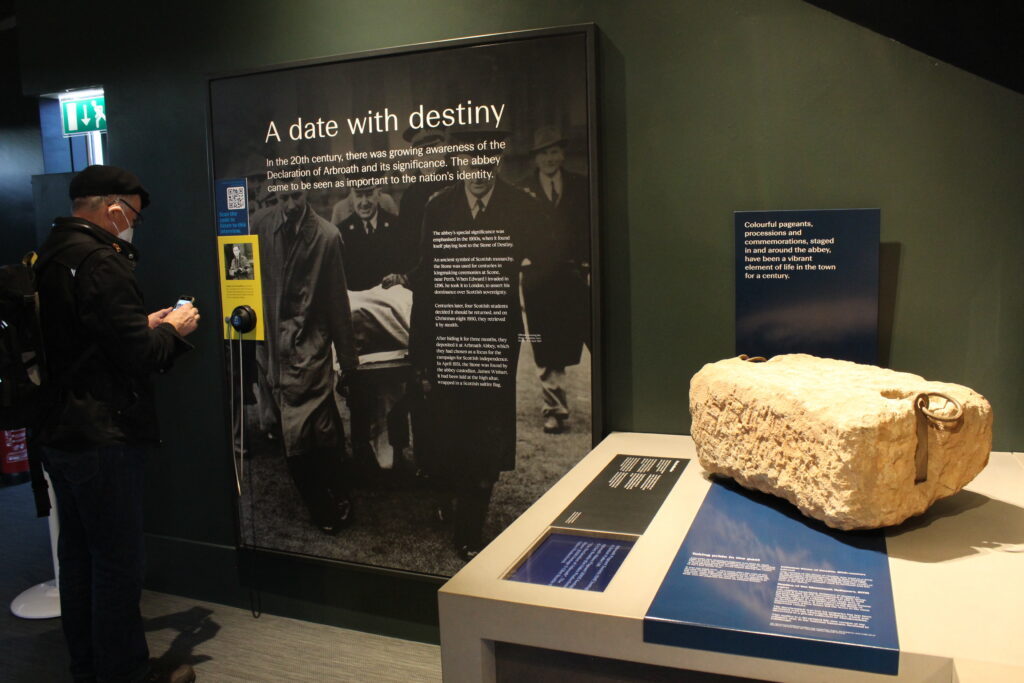
The context for its 2021 display, as part of a refurbishment of the Centre (more details in HES blog here), was a response to a local desire for the Stone’s Arbroath story to be told, and vice versa. (A specially commissioned interview with Ian Hamilton, the lead Glasgow student who took the Stone in 1950, provides audio context and colour.)
That drive for Arbroath’s Stone story to be told dates back to the return of the Stone to Scotland in 1996. Arbroath was one of places that placed an unsuccessful bid to provide the new home for the Stone (supported by ‘The Stone of Destiny. The Angus Connection’, a report by Norman Atkinson largely based on how the Stone was returned at Arbroath in 1951). Local, Wallace Ferrier was tenacious in the newspapers in 2013, noting Scone already had a replica. This prompted Norman to remind HES that they already had a replica.
It was from around 1997 that HES had been thinking about how to improve its provision for visitors to Arbroath Abbey, not least in relation to the 1320 Treaty. The Secretary of State for Scotland (1995–1997), Michael Forsyth MP, an Arbroath local, toured the Abbey with Historic Scotland’s Chief Executive Graeme Munro (6 February 1997) when announcing steps to improve presentation at the Abbey.
Forsyth had a personal interest in the Stone, having encouraged the Conservative Government to return it to Scotland in 1996. My former boss at Historic Scotland, Graeme told me in 2022 that he showed Forsyth the replica in the Abbey’s Regality Tower, where it was then stored: ‘I opened the door and said, this is the real one, you know. I mean, he just looked at me. I kept my head, in the literal sense’!
The serious point is that Historic Scotland, as it was then, had recently become aware that it had a replica. It had only just come to light. It seems that nobody knew that the replica was in the Abbey until an ex-member of Historic Scotland mentioned it. How it got there, nobody knows. The most useful near-contemporary source comes from the Arbroath Herald for 17 September 1999. It was discovered in a ‘dusty plywood box’ (note earlier Morris Scott description of a boxed stone). The journalist speculated, my emphasis, that it had been made for the Arbroath Pageant or was ‘one of a number of decoys made by stonemasons’, alluding here to the activities of Bertie Gray.
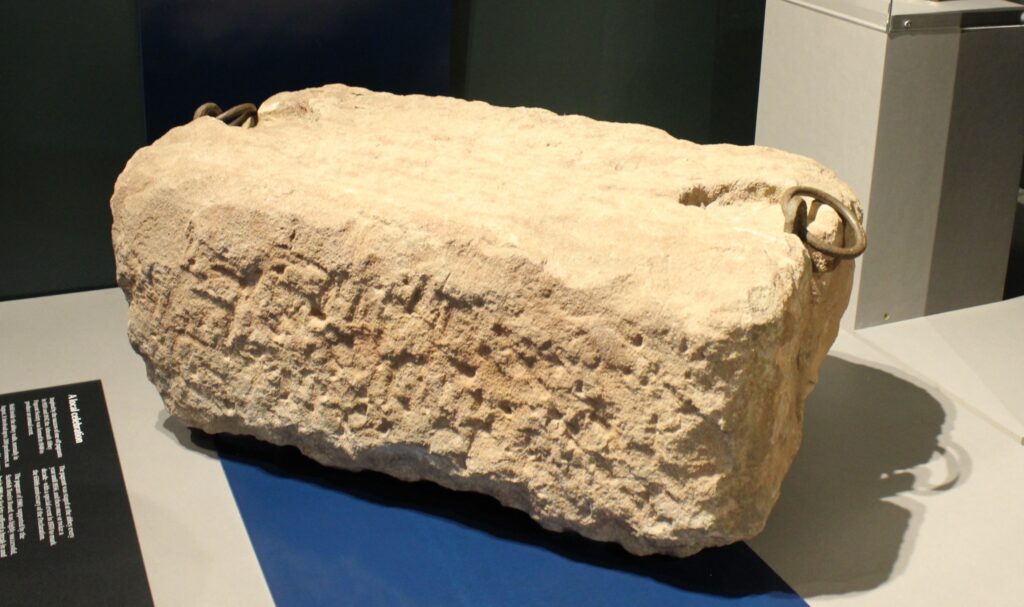
The Stone of Destiny replica on display in Arbroath Abbey (HES Accession number E1281; 285mm x 690mm x 415mm). It weighs 158.1 kg (pers comm Norman Atkinson).
It is not the Bertie Gray replica that went to Dundee, via Arbroath (above), and I have no evidence that it was made by Bertie Gray. It does not match the known description of the replica that police measured in his yard, for instance. Its vintage is unknown, although someone with expertise in metalwork might possibly be able to say something based on the metalwork. A geologist could only tell us its geological origins, but that might help us understand where it might have been made. It looks like a recycled building stone, but is its stone local to Arbroath, for instance?
When the historic original turned up on the high altar in 1951, the Abbey’s custodian was reported as wondering whether it was ‘something for the pageant’. The replica in the Abbey weighs an unwieldy 158 kg and would not be very practical for a pageant prop. Norman Atkinson’s earlier research was unable to find any evidence that this replica was created for or used by the Arbroath pageant. My own enquiries have drawn not just a blank, but also a rebuttal from several people with long memories of the pageant, including as performers.
It seems that an idea might have become a fact, albeit an attractive one given the distinctive character and fame of Arbroath’s historic pageant.
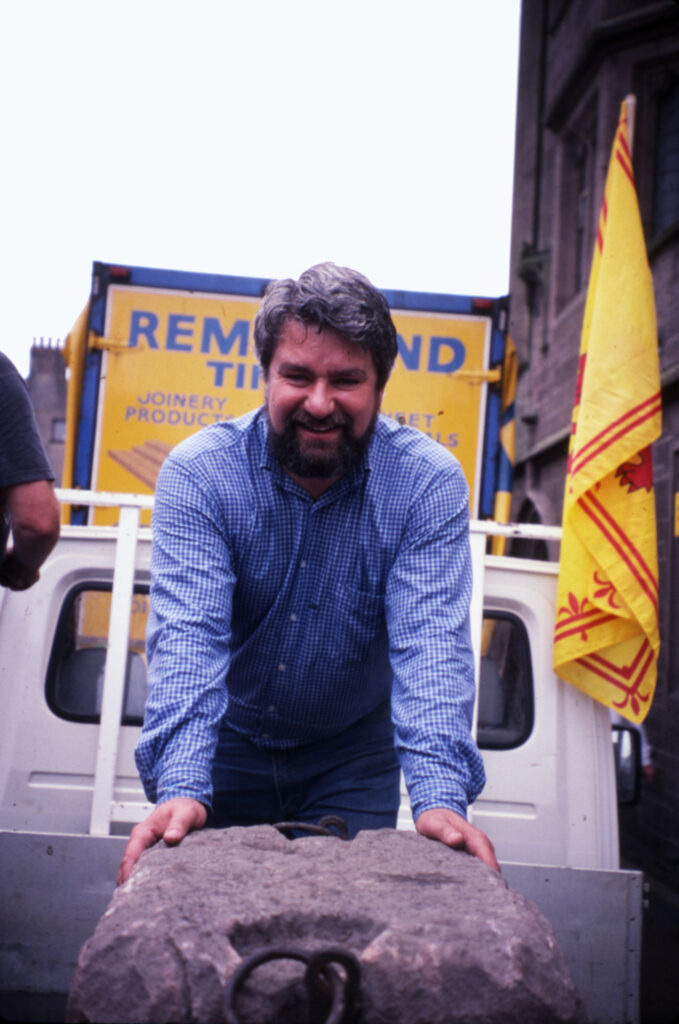
The replica of the Stone of Destiny now owned by Historic Environment Scotland, is loaded onto a lorry to take part in a procession through Arbroath, which sometimes had William Wallace snapshots interspersed among the mainly Robert I / Declaration of Arbroath celebrations. Copyright Norman Atkinson (in picture), with permission.
Certainly, before it was incorporated in the Abbey’s display, Norman Atkinson did take this replica through the streets of Arbroath between around 2000 and 2005, and it was temporarily displayed in Forfar’s Meffan Centre in 2005.
Can you add to this story?
If you know of other sources of evidence, or have stories about any of these replicas, do please get in touch with me.
Acknowledgements
For local information, I am very grateful to Norman Atkinson (pers comm 16 December 2024, 7 June 2025, Jim McGugan (pers comm 14 and 21 November 2024), Tina at Arbroath Festival (pers comm 10 November 2024), Grant Thoms, and Tam Walker through Norman Atkinson (pers comm 29 December 2024). At HES, I am grateful to Ross Irving (pers comm 21 November 2024). Graeme Munro kindly let me interview him (26 July 2022). By way of a postscript (3 July 2026), and with thanks to Joe McAllister and HES Archives colleagues, I have checked HES archives and can confirm that there is no record of the HES replica in the surveys of the Abbey’s ex-situ carved stones undertaken by Mary Márkus in 1996 (HES MS 5155/1. Acc No. 26304-8).
Some relevant written sources
- Arbroath Herald, 28 January 1972, ‘Stone of Destiny back in Arbroath but its authenticity disputed’
- Arbroath Herald, 5 July 1996, ‘April 11, 1951. Memorable event at Arbroath Abbey’.
- Arbroath Herald 1999, ‘Abbey keeps hidden its “Stone of Destiny”, 17 September 1999, by Gordon Cook
- Arbroath Herald, Letters to Editor from Wallace Ferrier, 22 March 2013, 19 April 2013
- BBC 1987. So who’s got the Stone, interviewers Archie P Lee and M McPherson. BBC Archives Programme number 504S407/1
- Broughty Ferry Guide & Carnoustie Gazette, 29 January 1972, ‘“Stone of Destiny” back in Arbroath but its authenticity disputed’
- Courier and Advertiser 1972, ‘Stone of Destiny in Dundee church?’, 10 June 1972.
- Courier and Advertiser, ‘Fresh debate over whereabouts of Stone of Destiny’, 17 June 2008. By Andrew Jarret
- Courier and Advertiser, ‘Prankster sells Stone of Destiny’, 19 Sep 2013. By Graeme Belcher
- Evening Telegraph, ‘Stone’s replica in Abbey’, letter to Editor by Phil Welsh
- Glasgow Herald. 1963. “Sculptor had three ‘stones’. Possibility of mix-up.” June 26, 1963.
- Historic Environment Scotland 2020. Statement of Significance. Arbroath Abbey & Arbroath Abbey Abbot’s House. Unpublished report, last reviewed 2015. https://www.historicenvironment.scot/archives-and-research/publications/publication/?publicationId=eadc85d1-d017-4dc2-bc2b-a57000c166a6 (accessed 25 February 2026)
- Scotsman 1972, ‘The Stone of Destiny seen again in the streets of Arbroath – or was it’, 24 January 1972