Public responses to my research on the untold and largely unknown fragmentation of the Stone of Destiny, and the lives of these fragments, is enriching and transforming the Stone’s story. It is doing so in some quite unexpected ways.
Bursts of widespread media interest since January 2025, including when the research was published in Antiquaries Journal in November 2025, have resulted in pulses of public contact with me. I can scarcely contain my excitement in opening such emails as they roll in. I aim to submit further research for future publication.
In this blog, I will give a sense of the direction of travel, drawing heavily on feedback from fragment holders (the sources of most of the anonymous quotes that follow).
As a family we felt able to speak more freely about having a fragment
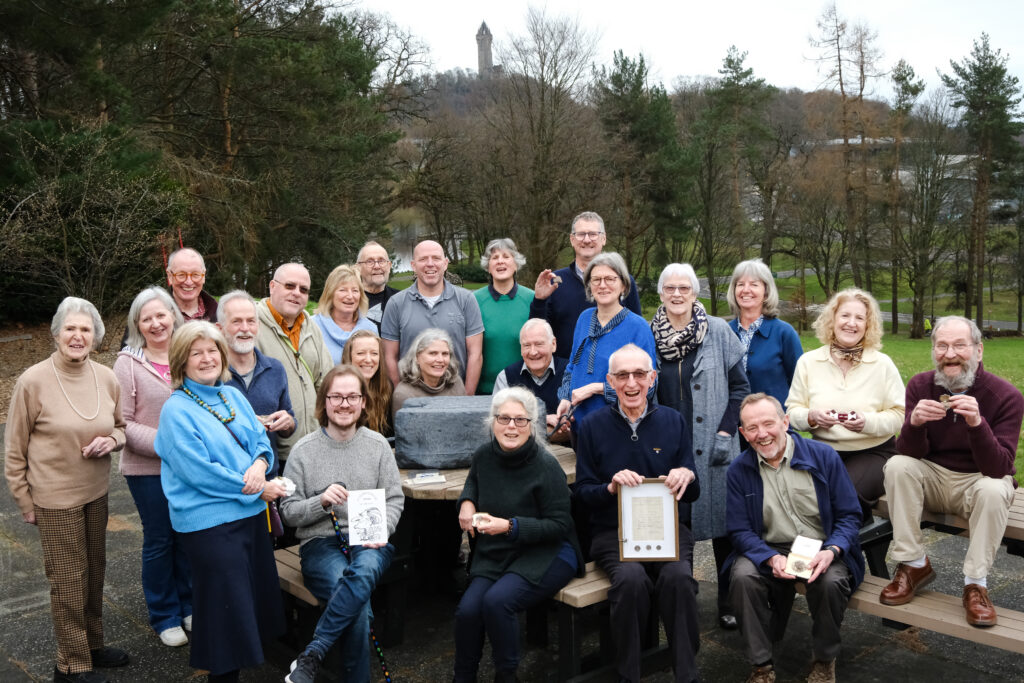
Recognising the bigger picture that was emerging from the individual stories, I asked myself what would happen if these people could be brought together. I knew what might link them, they did not. I invited them to come together for a research event at the University of Stirling on 5 March 2026 – The Fellowship of the Stone, as I called it. I brought together people with a family link to the life of the Stone of Destiny, including:
recipients of numbered fragments circulated by Bertie Gray, generated when the Stone was repaired in 1951
people linked to the deployment of a replica of the Stone that Bertie Gray had made, and
people linked to other fragments.
This was an invitee-only event, attended by a small number of researchers and curators, including Dr Rachel Walcott and Peder Aspen, geologists from National Museums Scotland, and Dr Mark Hall, curator at Perth Museum, the home of the Stone.
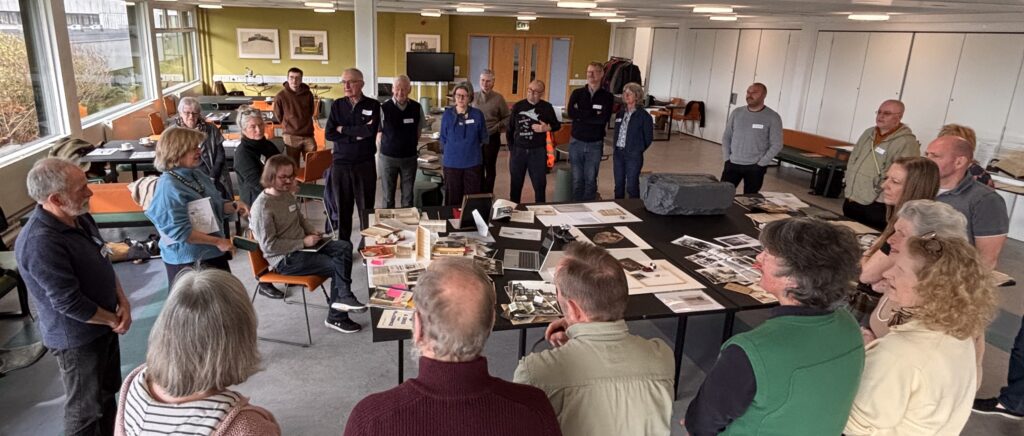
Attendees of the Fellowship of the Stone event. Photo: University of Stirling
The Fellowship of the Stone
‘Faces to fragments’ has been fascinating!
I had recognised that, while I was following up Stone stories with individual families on a one-to-one basis, there were research synergies that could arise from collaborative discussion among the group. And that the group would have questions they would like answered, or ideas about how their stories might be told. As a researcher, I also wanted to understand the difference this event would make, including to communal meanings and values.
During the event, someone commented on attendees’ shared experience of ‘the secrecy and spy-like aspect of keeping the Stone and maintaining the story’, and how this reflected the original ‘fellowship’ of those involved in the taking and hiding of the Stone, people with whom everyone present had, in some way, a connection.
I feel everyone felt so included – a real fellowship
I am less interested in the magic and mythic aspects that ‘fellowship’ throws up, but I do think it has been very useful to have the ability to feel just one of many next generations who have puzzled over whether to enjoy or conceal (or both) this event in family history
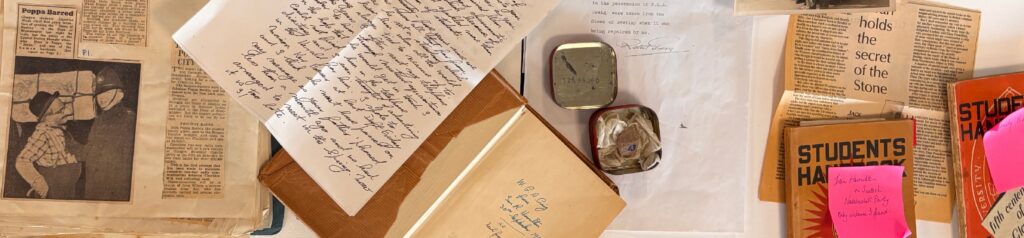
Slice of memorabilia brought to the event by Bill Craig’s family
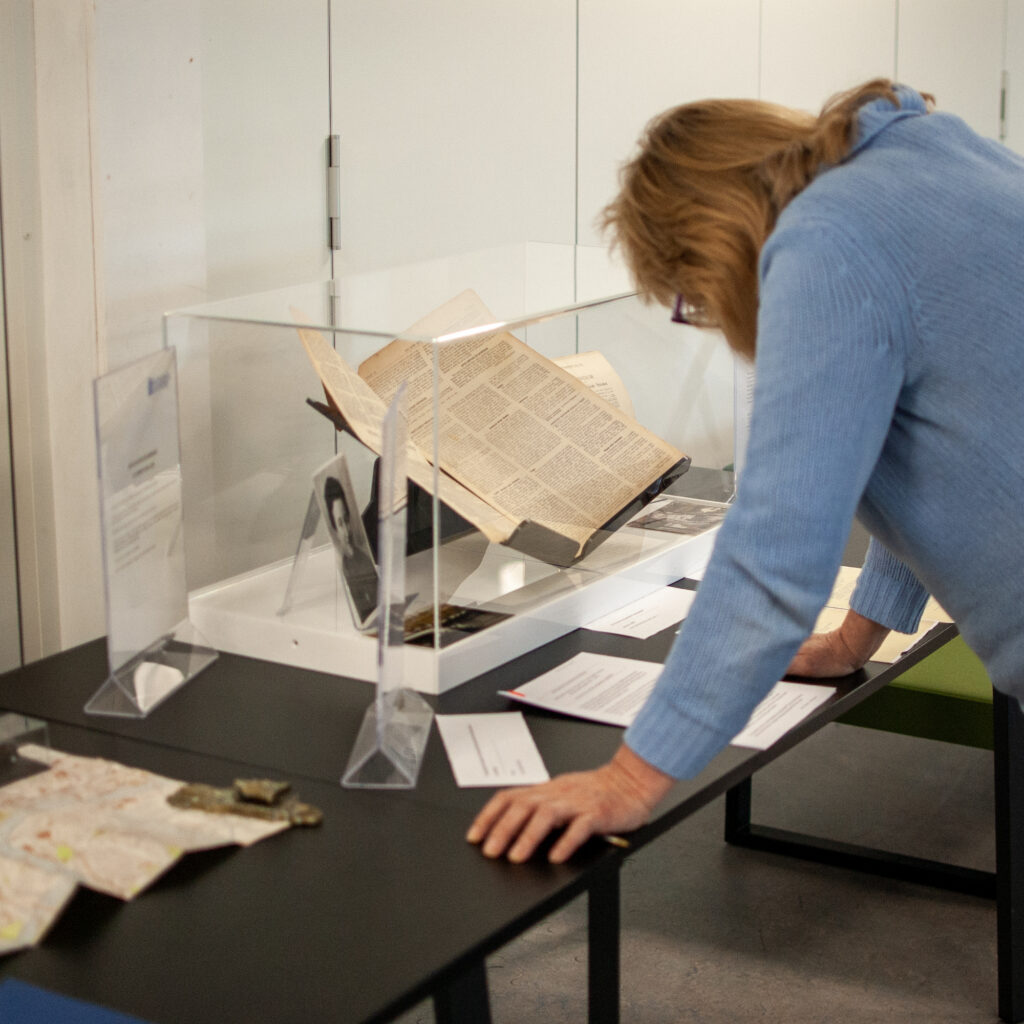
Fellows were warmly invited to bring along and show their fragments, associated documents and other memorabilia that helps to place them in the context of the people to whom they were given or though whose hands they have passed. The archivist from the University of Stirling’s Scottish Political Archive was also in attendance and displayed relevant material from our collection.
An attendee absorbs a display from the collections of the Scottish Political Archive
Perhaps the highlight of the day was when we all stood around the large display table and everyone told their stories, picking up and sharing what they had brought along. Indeed, the earlier excitement, as everyone unpacked their bag, in one case a suitcase, and we waited eagerly to see what would appear! With prior knowledge of most of their stories, I arranged it so we could see how new understandings of the life of the Stone were emerging, and how they fitted in.
Attendees share stories with fragments and memorabilia
I felt that the event was like a puzzle board and all the pieces were being pieced together by different people; connected, but different people (visiting researcher)
It is so fascinating to hear about the connections – the ‘before and after’. Hearing the stories today only increases my interest
I found it delightful witnessing the participants discovering the connections they had with each other. In some cases the connections were two generations back…It felt like the connections were being salvaged just before they disappeared from memory (attendee from National Museums Scotland)
New stories
There will be many strands to my forthcoming publications, not least understanding the social value of the fragments / the Stone across two to three generations of the same families, all of whom are caring and responsible stewards of pieces of ‘Scottish gold’, as one participant described it.
But underpinning these perspectives will be new knowledge about the life of the Stone, how it fragmented through time, and the social lives of the resulting fragments.
To cut a very long story short, my Antiquaries Journal article mainly drew on diverse documentary sources to construct a history of the Stone’s known fragmentation, and the location was known of only a small number of surviving fragments: two in museums, one in family care, one pending a decision on its future (the MacCormick fragment), and a number of British Geological Survey geological samples, one now mounted in the royal Diamond Jubilee State Coach. I began with a new report of the Stone’s apparent fissure in 1838 and resultant geological samples, noted later Victorian geological samples, and then focused on what was known about how the Stone was fragmented between Christmas 1950 and April 1951. This is the period that the Stone was removed from the Coronation Chair in Westminster Abbey, in the cause of promoting the need for Scottish Home Rule, was hidden and then returned (the king was dying and it would be needed for the future queen to be crowned upon). The Stone had broken into two parts when removed from the Chair, and my main revelation was that, during its repair before it was returned, a man called Bertie Gray had collected and later circulated 34 numbered fragments, along with certificates of authenticity. But where were these fragments now? I could document the early life of fragment 25 and identified the lives of some other Gray fragments, but did not know if these were numbered.
So, what difference did the public responses make? Research on all of these is still ongoing, including with colleagues in National Museums Scotland, but it seems that:
fragments survive from the 1830s, removed when the Stone was still in Westminster Abbey. This includes one from when the Stone was ‘wickedly fractured’ in 1838, as an antiquarian subsequently described the event in 1852.
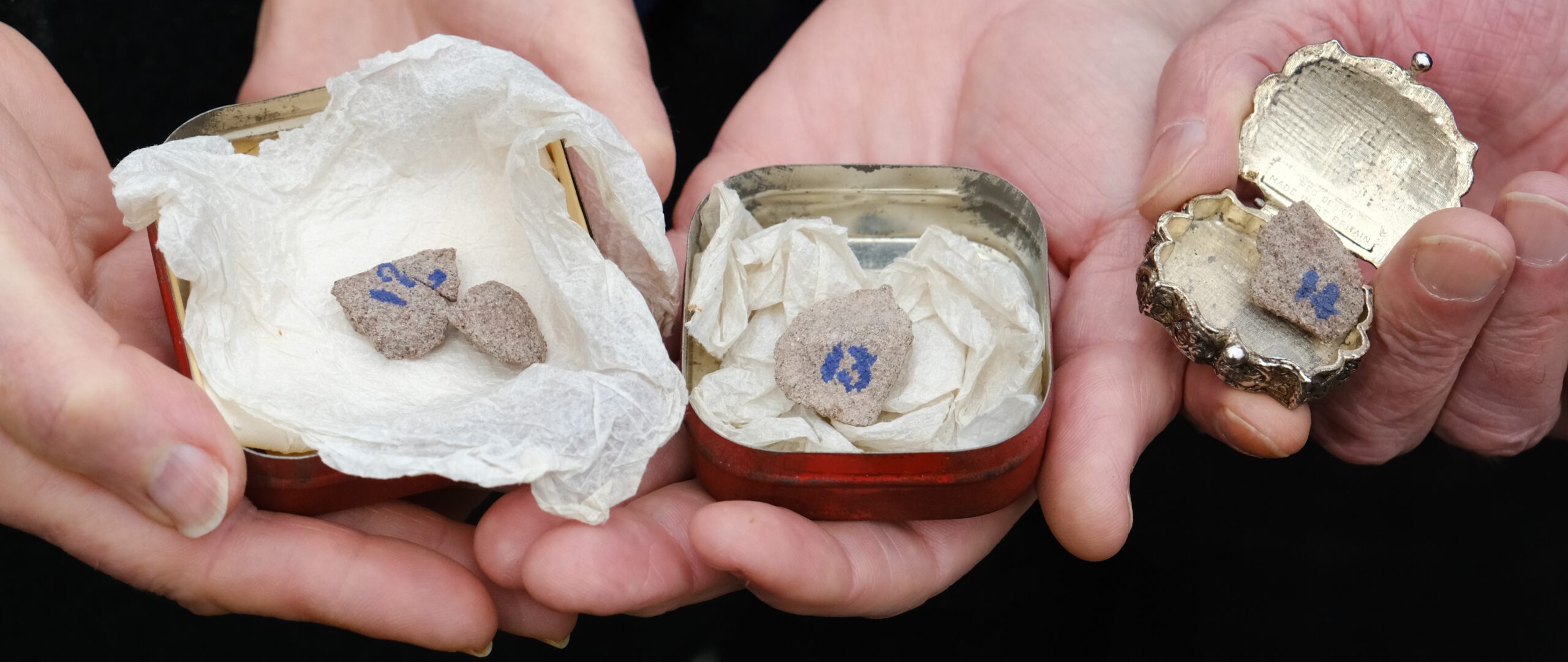
Bertie Gray painted numbers on fragments: 12, 13, 14, 17, 24 and 25 are the only examples I know anything specific about, however (25 is unlocated but went to Canada with journalist Dick Sanburn).
Bertie Gray also handed out many unnumbered fragments of Stone – smaller pieces than those he could number, I believe.
Bertie Gray also retained and distributed some ‘sand’ from the Stone.
Bertie Gray was not the only person to retain and distribute pieces of Stone from the repair – Willie Whyte also did so. Before its return, the Stone was repaired in the house he shared with his wife Kathleen, in Bearsden, and it seems he kept and distributed among friends and family what I would characterise as the sweepings from the repair.
As I learnt only a few weeks ago, there was yet another unreported fracture episode. When the smaller part of the broken Stone was carried into a Glasgow house to be hidden, Ian Hamilton and a comrade dropped it and several pieces broke off. The family kept a fragment, and I can guess what probably happened to one of the other pieces.
The curation of fragments that were thought to be the Stone lend themselves to yet another untold event in the Stone’s secret life in Scotland.
The curation and life of a phial of Stone grains opens the door to better understanding the life of a Bertie Gray replica of the Stone and how it was put to political ‘work’ by a group of Scottish nationalists in the decades after the Stone was returned to England, three of whom can now be identified (the ‘Guardians’ or ‘Keepers of the Stone’).
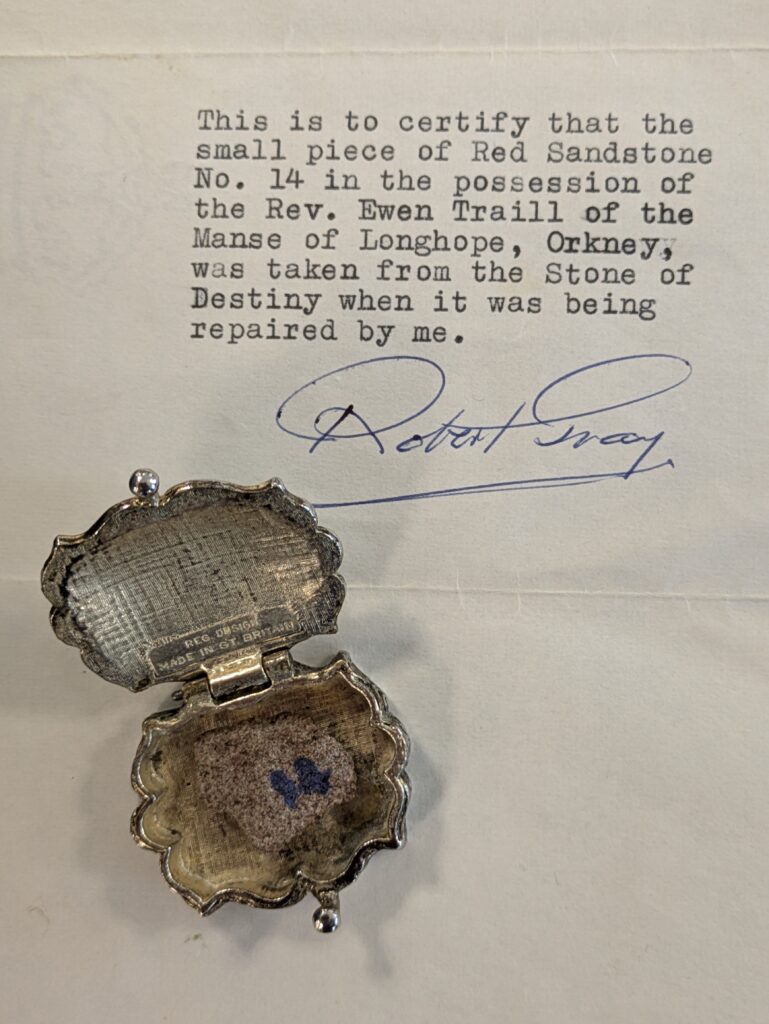
An extract from Bertie Gray’s letter of fragment authentication to Ewen Traill
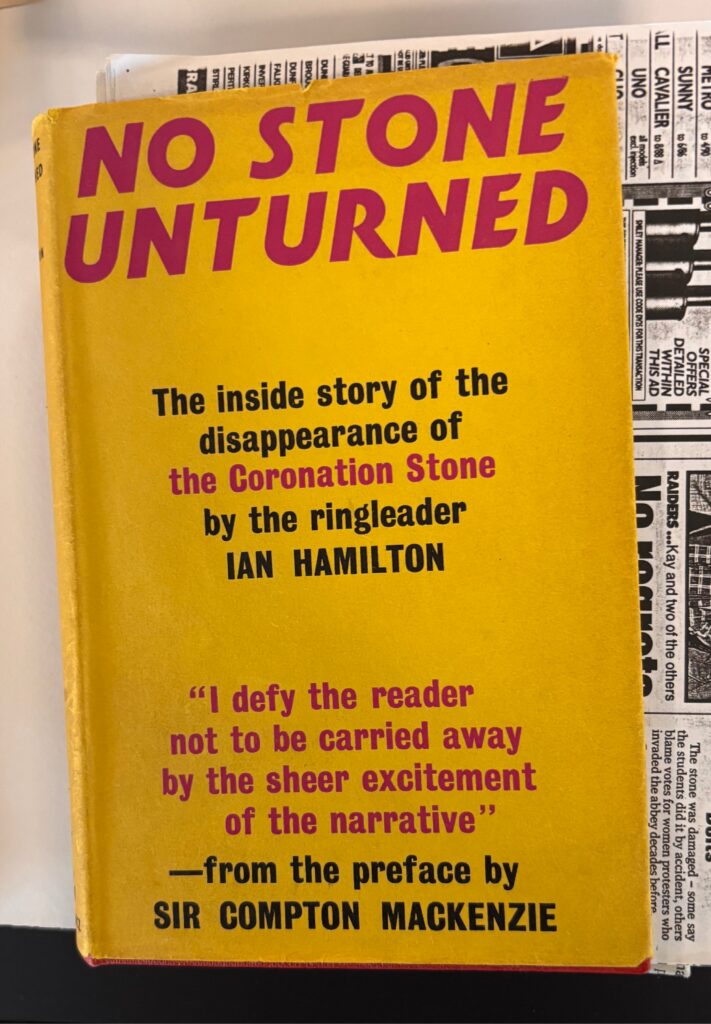
For a near contemporary account of events, we have all had to largely rely on Ian Hamilton’s 1952 book, No Stone Unturned. But he was not party to all events and stories, was deliberately selective about what he told, and there were parts of the story he did not pretend to cover or necessarily know about. The fragments are bringing forth those other stories, and much more.
Ian Hamilton’s ‘inside story’ about the Stone, published in 1952, and reprinted many times since, from Craig family collection of memorabilia
It has broadened my outlook from – to – the broader bond of protagonists; thence to Scottish cultural implications
This is just the process of fragmentation – the meanings and understandings that arise from better understanding these events and what then happens, and who is involved, is where the real richness lies in the future story telling. There is a rich and indeed emotional example, which I look to fully report in a developed form in due course. This story emerged as I, and the families concerned, got to the bottom of why Gray fragment 14 had passed through both their hands. ‘Lost’ to the current descendants of Bill Craig, who knew Gray had gifted it to their father, it had ended up in the possession of the son of Ewen Traill, gifted to him by Craig in very poignant circumstances.
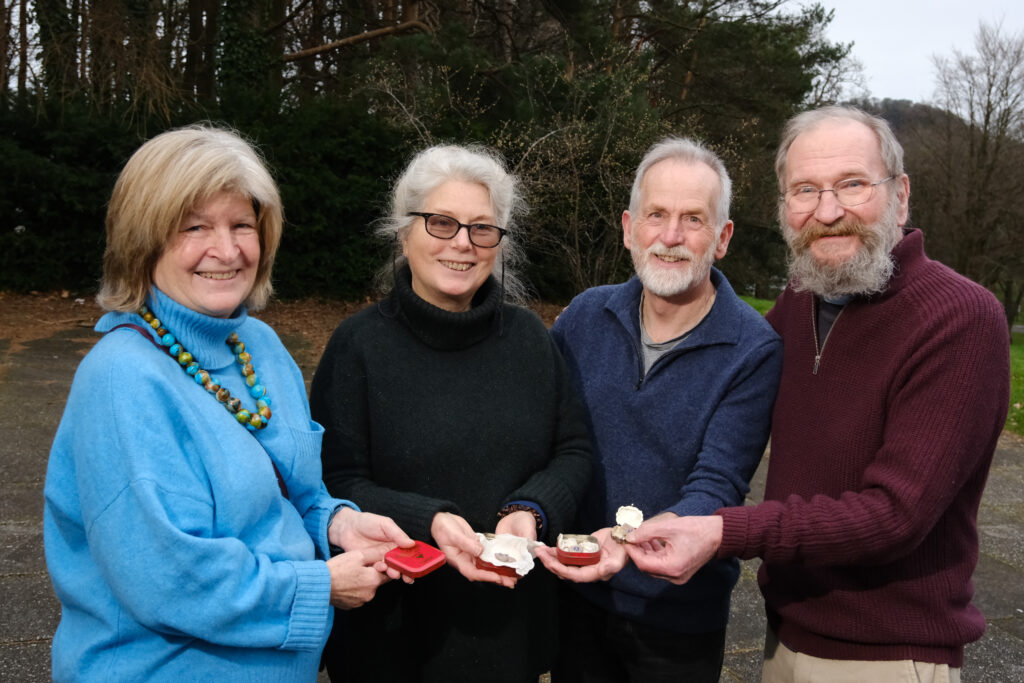
Mary, Margery and Jimmy Craig reunite fragments 12, 13 with 14, now held by Wallace Traill. Photo: University of Stirling
Bill Craig (W.G.A. Craig) was President of the Glasgow University Men’s Union when the Stone was removed in 1950/51. He was heavily involved in the planning and implementation of the heist (he is the ‘Neil Rock’ character in Ian Hamilton’s 1952 book since he initially sought anonymity).
Ewen Traill was one of two brothers who in 1936 had temporarily stolen Wallace’s Sword from The National Wallace Monument, in an earlier protest for Scottish political freedom. The Fellowship meeting of 5 March united the current generation of families and reunited the fragments.
It brought me greater awareness of the wider context of the Stone and the repatriation, a recognition of the story of fragments outside of the family. It also made me proud to see part of our family story told
I feel that the story should be told, and there is a possibility that it can be as complex as it needs to be in order not to leave it in the “student prank” category, and possibly to understand again and for today that nationalism is a broad church
This is much bigger than my family. I would like to consider how the story of the fragments could reach the wider public
On the basis of provenance, fragments are now known to survive in Scotland, England, Australia, Canada and Norway. Since compiling my article, I know of one further apparent fragment of the Stone that is in public care, at least 30 fragments (around 20 small pieces forming one assemblage) survive with families, and I have identified the existence of another five examples from documentary or oral sources only. Peder Aspen, Associate Researcher at National Museums Scotland, very kindly undertook a preliminary examination of all the fragments brought to the 5 March Fellowship event, and there is no reason to rule these out on geological grounds as having come from the Stone.
‘This story is not going to end’
The Stone has come alive. I thought about it as a story from past – but now I feel it is more dynamic. And is ongoing
This is indeed the Stone that keeps on giving. It can be expected to do so long after I publish the further developments and bigger picture, but that will be a very positive impact and legacy.
The research and event have allowed us to be more curious and less fearful of telling our tiny part of the story and perhaps made us think what we might do with our fragments in the future
Meantime, I am still keen to learn of further fragment stories, including from people who have made preliminary contact but perhaps felt shy to follow this up with me. My research is all ethically conducted, approved in advance by the General University Ethics Panel.
I found it fascinating to hear the stories that were told by other recipients of fragments of the Stone and interesting that our generation are quite happy to speak more openly about our family’s past involvement. Obviously in the past there would have been some trepidation about the possession of fragments
The whole day has been so interesting, friendly and more importantly non-threatening. I feel excited that the stone may have a future that is not in a box and in a drawer e.g. in an exhibition
Acknowledgements
The Fellowship of the Stone event was supported by a grant from the University of Stirling’s Centre for the Sciences of Place and Memory. I thank the Centre for its grant, the invaluable practical and intellectual support its staff and students very kindly provided on 5 March, notably John Sutton, Tânia Casimiro, Phil Gould and Rhona Nic Dhùghaill. I also thank the external colleagues who attended and provided input (see above). It is a measure of the interest of ‘Fellows’ that they joined us from across Scotland and England, travelling at their own expense, and I thank all 18 of you for your curiosity, thirst for knowledge, desire and willingness to share, and good humour. This includes John who patiently joined online from Canada, and Tânia who acted as his Stirling ‘buddy’ for the day. I wish I could bottle and share the excited buzz of your voices enthusiastically engaging with each other around the display table – it was a pleasure to adapt the day’s schedule to let this interaction run more of its natural course! I must also thank ‘Fellows’ who could not attend who have I have since met, interviewed, and in whose hands the story continues to amplify and evolve. Peter Swindon continues to support this research from the University Communications Team, and I am particularly grateful to him for arranging professional photography, some of which is included above. Rhona Nic Dhùghaill and Rod McCullagh are to be credited with providing additional photography.